

Power to the People — Free Justice — Public Accountability
Pakistan Tehreek-e-Ijtihad
Manifesto Theme 02

Judicial Reforms (Insaaf Bin Daam)

The party's documented proposals for zero-cost dispute resolution, local community conciliation, and citizen jury participation as published in official manifesto literature.

Party Manifesto: Point 5 (Urdu Edition, pp. 12–15) / pp. 24, 29–34 (English Translation Compilation)
Documented Reform Proposals

The Six Pillars of Judicial Reformation

Preserved across pages 24 to 34 of the official English compilation, the movement outlines six procedural and structural proposals for the legal system:

01Manifesto (English Translation Compilation), pp. 29, 33

Party's Documented Policy of Insaaf Bin Daam (Free Justice)

The party proposes the complete abolition of court fees, litigation stamp duties, and prohibitive advocate charges for ordinary citizens, documenting that legal costs currently force families to exhaust their savings and sell assets to seek redress.

Documented Details:

  • Zero litigation fees for civil and criminal disputes at the local unit and district levels.
  • Removal of financial barriers that prevent impoverished citizens from seeking legal remedies.
  • Mandate that the state bears necessary witness travel expenses where a convicted party is unable to pay.
02Manifesto (English Translation Compilation), pp. 24–25

Party's Documented Model of Local Conciliation and Imam-as-Judge

At the basic unit level (village or municipal ward), the party proposes that the local Imam/Qazi—appointed via competitive public examination and given civil service status—serves as the primary conciliator to hear and resolve disputes in the presence of the community assembly.

Documented Details:

  • Mosques serving as community arbitration centers during appointed hours.
  • Open dispute hearing before the local congregation to ensure factual transparency.
  • Imams provided standardized government grades, training academies, and regular national rotations to prevent local bias.
03Manifesto (English Translation Compilation), pp. 24, 31–32

Party's Documented Citizen Jury and Community Adjudication

If a dispute cannot be resolved individually by the local conciliator, the case is placed before the 11-member basic unit assembly. Members participate by rotation in hearing testimonies, establishing character credibility, and delivering community verdicts.

Documented Details:

  • Eleven-member elected local councils (*Punchaits / Majalis*) serving as community judicial bodies.
  • Rotational participation of local unit members to announce verdicts and cultivate civic responsibility.
  • Character validation of witnesses directly verified by their respective local administrative units.
04Manifesto (English Translation Compilation), pp. 24, 32

Party's Documented District & Mobile Judicial Councils

The party proposes District Judiciary Councils to review local unit decisions on technical legal grounds, alongside Mobile Judicial Councils authorized to proceed directly to incident sites to record primary evidence without procedural hindrance.

Documented Details:

  • District Judiciary Councils serving as technical appellate bodies for local conciliation decisions.
  • Mobile Judicial Councils visiting dispute sites to conduct immediate on-the-spot fact-finding.
  • National-level supervisory judiciary council to maintain procedural transparency across all subordinate units.
05Manifesto (English Translation Compilation), pp. 29–30

Party's Documented Elimination of Intermediaries and Touts

The manifesto identifies predatory legal middlemen, informal touts, and unverified stamp-vendors as primary sources of litigation fraud. It proposes making property conveyancing contingent on certified legal counsel with statutory liability for forgery.

Documented Details:

  • Mandatory requirement that property transactions be conducted through certified legal counsel rather than informal stamp-vendors.
  • Statutory accountability and legal action against legal practitioners found complicit in fraudulent deeds.
  • Streamlined direct filing procedures through local administrative units to eliminate exploitative courthouse brokers.
06Manifesto (English Translation Compilation), p. 29

Party's Documented Statutory Timeframes & Legal Accountability

The party advocates statutory deadlines for resolving civil, criminal, and appellate proceedings, structural separation of civil and criminal benches, caseload limits for advocates, and disciplinary termination for dilatory performance.

Documented Details:

  • Mandatory timeframes for the completion of trials, appeals, and judicial reviews.
  • Structural separation between civil and criminal court benches, judges, and practicing lawyers.
  • Establishment of peer-review juries of senior jurists to monitor lawyer and judge performance, with powers to fine or revoke licenses.
Authentic Source Excerpts

Direct Passages from Judicial Chapters

Unedited excerpts documenting the party's published proposals on legal reform:

“Thus, the public would be able to get justice on their door-steps without paying heavy fees, interruption and delay.”

Party Manifesto (English Translation Compilation), p. 33

“If an unfortunate family is entangled in some lawsuit, all the savings of their life is gorged by the police, their property is sold to pay expenses for the judicial process... There should be a determined time frame for the decision of cases, appeals and reviews within which the decision should necessarily be taken.”

Party Manifesto (English Translation Compilation), p. 29

“As a government office-holder, the 'Imam' of the mosque as 'judge' in local units, assemblies, communities, Majlises or 'Punchaits' would assist on permanent basis as the secretary or the speaker. In case of any dispute, the related parties will take the matter to the judge.”

Party Manifesto (English Translation Compilation), p. 24
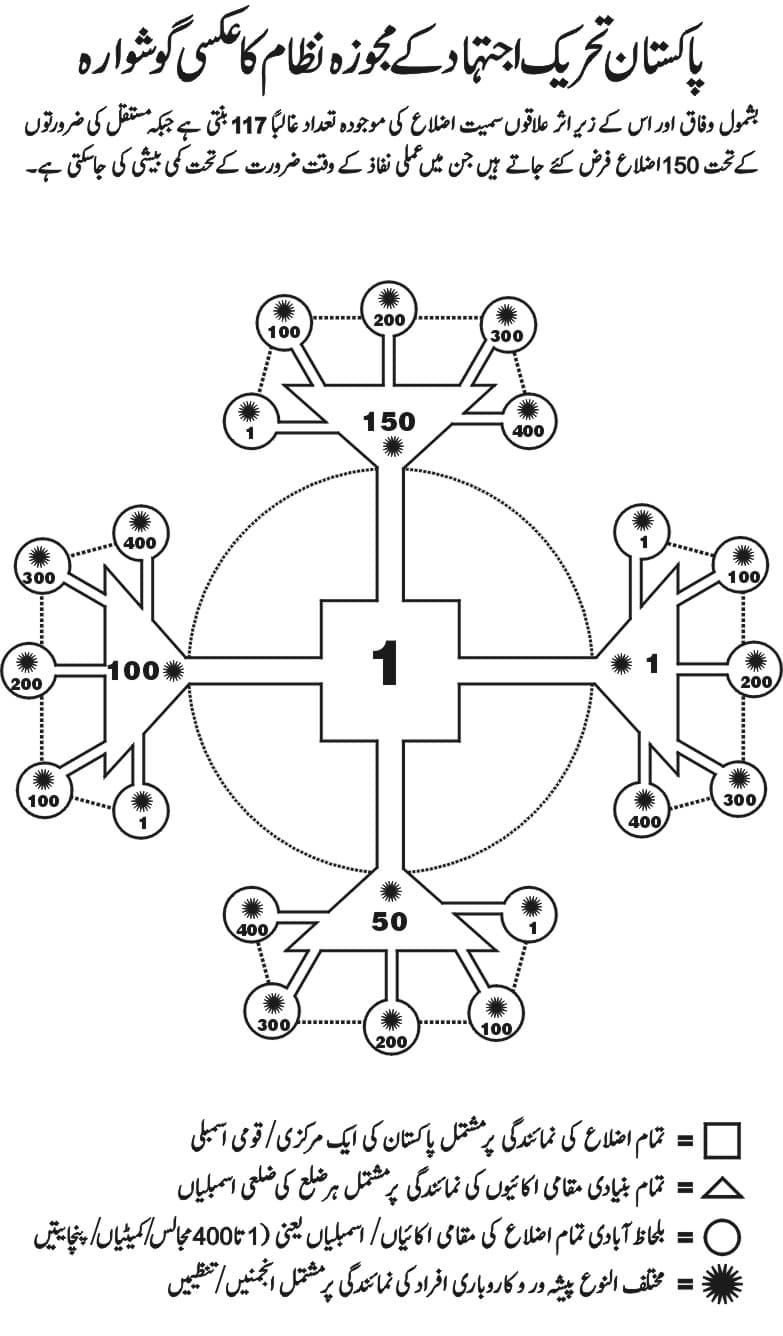
Archival Devolution Diagram

Governance Schematic: The Goshwara Model

Proposed District & Local Council Devolution (گوشوارہ)

The authentic party Goshwara diagram illustrates the proposed structural decentralization of administrative and judicial powers down to 11-member village and ward units, with direct local dispute conciliation, municipal autonomy, and technical district councils.

Proposed District & Local Council Devolution (گوشوارہ)
Archival Governance Chart • Decentralized District Administration Model