Power to the People — Free Justice — Public Accountability
Digital Constitutional Archive

Constitution Article Browser

آئینی دفعات و شقوں کا باضابطہ مطالعہ

An authoritative, clause-by-clause digital browser of the Constitution of Pakistan Tehreek-e-Ijtihad (adopted 06 February 2017, updated 01 January 2024). Transcribed faithfully from the registered 14-page Urdu Constitution booklet.

01 January 2024ECP Enlistment: F. 2(38)/2016-Confd (10 May 2017)
Archival Transcription Notice

All provisions presented on this portal are transcribed directly from the Party's authentic 14-page Urdu Constitution booklet (pages 41–54).

English translations are provided as a faithful reference rendering to assist study; the binding constitutional baseline registered with the Election Commission of Pakistan is the authentic Urdu text.

Institutional Clarification: This document is the internal governing charter of Pakistan Tehreek-e-Ijtihad under the Political Parties Rules 2002. It is completely distinct from the sovereign Constitution of the Islamic Republic of Pakistan, 1973.

Preamble (Harf-e-Tamanna)Source: Constitution booklet, p. 43

Constitutional Preamble — Harf-e-Tamanna

حرفِ تمنا: (تمہید)

Surah Al-An'am (6:159) / سورۃ الانعام (6/159)

“Indeed, those who have divided their religion and become sects - you are not associated with them in anything.”

In extreme brevity, since the establishment of the God-given 'Islamic Republic of Pakistan' to this day, the plight of the poor has not improved, but has rather deteriorated. The general public has grown weary of factional parties that safeguard landlords and capitalists and operate contrary to Quranic injunctions—parties whose politics are confined merely to elections and looting, ultimately giving rise to self-serving authoritarianism.

Religious parties, likewise, have brought the country and the nation nothing except sectarian fragmentation and fanaticism. As the Holy Quran declares: 'Indeed, those who have divided their religion and become sects - you are not associated with them in anything' (6/159). Truly, the Quran considers schism and discord to be a severe chastisement—not temporary or transient, but enduring and perpetual. The Quran affirms that it came to erase all forms of discord. Adherence to divine laws is a collective endeavor, and shared faith constitutes the unified Ummah and the foundation of universality, in accordance with which, as long as the Ummah remained steadfast upon the system of Salat and Zakat, it did not splinter into sects.

The founding fathers of the nation brought 'Pakistan' into existence under the vision that a genuine Islamic collective system (Nizam-e-Ijtima'iyyah) would be established wherein humanity, especially the downtrodden, would benefit from basic amenities, and the grievances of all would be redressed without discrimination or prejudice. In such an order, enduring democratic traditions, development and prosperity, peace and security, unity and solidarity, territorial integrity, and national self-reliance would take firm root.

It was envisioned as an order where practical life would reconcile with worship such that the rights of fellow beings (Huquq-ul-Ibad) and the rights of God (Huquq-Allah) would be discharged simultaneously with uniformity, where 'the public and Islam' would not be exploited, and where the nation would neither be divided nor disorganized, but instead set upon the path of economic and social justice.

Tragically, this could not be realized, and consequently the nation and country have today become a breeding ground for extremism, terrorism, and corruption. A state within a state has emerged. In respect of rectifying these conditions, the following organization is hereby established. May Almighty Allah create ease for all of us. Ameen.
Clause 1ضمن - 1
Source: Constitution booklet, p. 43

Party Name (Movement)

تحریک (جماعت) کا نام

The movement hereby initiates the formal establishment of a genuine popular political party under the official designation "Pakistan Tehreek-e-Ijtihad (PTI)" (پاکستان تحریکِ اجتہاد), grounded upon the revolutionary reform call articulated in the 600-page foundational treatise "Kya Yeh Mumkin Hai?" authored by journalist and thinker Altaf Hussain Anwar (Saqi).

The movement is instituted to transform our beloved homeland, the "Islamic Republic of Pakistan", into an exemplary and modern Islamic welfare state wherein fundamental human rights are honored and every citizen—without distinction or prejudice—enjoys a life of peace, security, and tranquility. Freedom of expression is safeguarded so that ordinary citizens are encouraged and empowered to resist wrongdoing with the highest degree of faith.

Pakistan Tehreek-e-Ijtihad enters the arena of practical action to vindicate the Quranic affirmation that no human-devised law or administrative system can substitute for divine guidance. Consequently, genuine national reform remains impossible until our society is restructured into an authentic Quranic order of universal justice.

Clause 2ضمن - 2
Source: Constitution booklet, p. 43–44

Objectives of Pakistan Tehreek-e-Ijtihad

پاکستان تحریکِ اجتہاد کے مقاصد

The establishment of Pakistan Tehreek-e-Ijtihad (PTI) represents a conscious, historical, and political response to objective national realities, with its foremost objective being the rigorous implementation of its attached manifesto.

The party's foundational goals include dismantling cultures of self-serving patronage, eliminating unequal double standards, rectifying the unjust distribution of resources, eradicating feudal and capitalistic VIP privileges, and curbing systemic coercion against marginalized social classes across public and private spheres.

Core socio-economic objectives include distributing agricultural units to landless cultivators on self-farming terms, balancing rights with civic obligations and income with expenditures, restructuring the tax framework in accordance with Islamic values, and enforcing universal quality education.

To guarantee women's rights and their equal participation in decision-making and legislative bodies in accordance with Quranic injunctions, ending domestic violence and legal ignorance, recognizing that men and women share joint responsibility in governance (Surah Ali 'Imran 3:110 and 3:104-105).

The party is registered pursuant to Article 17 of the Constitution of Pakistan to give practical realization to national constitutional ideals, including Article 25 (equality of citizens), Article 33 (discouragement of parochial prejudices), Article 34 (full participation of women), Article 36 (protection of minorities), and Article 40 (promotion of international peace and Islamic brotherhood).

Rejecting colonial "Divide & Rule" tactics in favor of an egalitarian "Unite & Rule" doctrine, the movement struggles to realize: "Power to the People • Justice at Zero Cost • Open Public Accountability", ensuring that an enlightened citizenry becomes the sovereign master of its own destiny.

Clause 3ضمن - 3
Source: Constitution booklet, p. 44–50

Organizational Structure

تنظیمی ڈھانچہ

The organizational structure of Pakistan Tehreek-e-Ijtihad operates on equal democratic footings for men and women across local, district, and national (central) tiers, organized into standardized executive councils and assemblies.

From grassroots neighborhood units to the central secretariat, all organs are established upon constitutional and consultative foundations to permanently eliminate dynastic politics and hereditary control.

Constitutional Sub-Clauses & Detailed Framework

3(A)

Clause 3(A): The 15 Constitutional Office-Bearers & Powers

Source: Constitution booklet, p. 44–46

Under the organizational procedures defined in the party constitution, any Pakistani citizen meeting statutory eligibility may be inducted into executive units.

The 15 constitutional office-bearer designations, standardized across national, district, and local tiers, are defined as follows:

Clause 3(A): 15 Constitutional Office-Bearer Designations

Preserving the original constitutional titles, hierarchy, and duties defined in Clause 3(A) (i)–(xv):

i

Founder of Pakistan Tehreek-e-Ijtihad

بانی پاکستان تحریکِ اجتہاد (پی ٹی آئی)

Founder Altaf Hussain Anwar (Saqi), author of foundational treatises; holds lifetime founding constitutional status and transitional appointment authority pending nationwide organizational completion.

ii

Patron-in-Chief

سرپرستِ اعلیٰ

Elected from the Advisory Council (Mehfil-e-Mudabbiran); provides supreme moral and institutional guidance across party assemblies.

iii

President

صدر

Chief Executive of the respective local, district, or national tier; presides over assemblies, executes decisions, and oversees subordinate units.

iv

Senior Vice President (Women's Affairs)

سینئر نائب صدر (سیکرٹری خواتین)

Deputizes for the President and oversees women's councils, ensuring equal participation and presiding in presidential absence.

v

Vice President

نائب صدر

Assists in organizational administration and assumes acting executive responsibilities in the absence of senior leadership.

vi

General Secretary

جنرل سیکرٹری

Principal administrative officer; coordinates secretariat proceedings, maintains official records, and oversees subordinate organizational communications.

vii

Joint Secretary

جوائنٹ سیکرٹری

Assists the General Secretary in administrative management and acts in secretarial capacity during the General Secretary's absence.

viii

Finance Secretary (Treasurer)

سیکرٹری مالیات (خزانہ)

Custodianship of financial accounts, bank operations, serialized receipt issuance, and preparation for statutory audits.

ix

Information Secretary (Spokesperson)

سیکرٹری اطلاعات

Official party spokesperson; responsible for press releases, media liaison, and communicating official policy positions.

x

Publications & Media Secretary

سیکرٹری نشر و اشاعت

Oversees the publication, printing, and nationwide distribution of official literature, treatises, and manifestos.

xi

Social Media Secretary

سیکرٹری سوشل میڈیا

Directs digital platforms, official websites, and electronic communications networks in accordance with party policy.

xii

Women's Secretary

سیکرٹری خواتین

Mobilizes female membership, coordinates women's assemblies, and safeguards women's rights and representation.

xiii

Youth Secretary

سیکرٹری نوجوانان

Organizes youth and student wings, mobilizing volunteer networks and promoting civic and ideological awareness.

xiv

Legal Affairs Secretary

سیکرٹری قانونی امور

Provides non-commercial legal counsel, ensures statutory compliance with ECP regulations, and handles legal filings.

xv

Council of Mentors / Special Aides (Think-Tank)

محفلِ مدبران / معاونینِ خصوصی (Think-Tank)

Advisory council of senior jurists, intellectuals, and policy specialists providing strategic counsel and ethical oversight.

3(B)

Clause 3(B): National / Central Organization

Source: Constitution booklet, p. 47

The National (Central) Organization comprises elected Presidents and General Secretaries from all district executive units across the country.

Maintains an equal gender balance from each district. The national organization directs nationwide policy, oversees the Central Secretariat, and manages statutory relations with the Election Commission of Pakistan.

3(C)

Clause 3(C): Governance Model Structured on Party Organization

Source: Constitution booklet, p. 47

Proposes a public devolution governance framework modeled directly upon the party's decentralized organizational structure.

Mandates that any party official elected to constitutional public office must relinquish party executive posts to prevent the concentration of political power.

3(D)

Clause 3(D): District Organization

Source: Constitution booklet, p. 47

The District Organization is composed of the elected Presidents and General Secretaries of all local neighborhood and village units within the district.

Coordinates district-level public programs, worker mobilization, financial oversight, and liaises directly with the central secretariat.

3(E)

Clause 3(E): Local Organization & 11-Member Peer Selection System

Source: Constitution booklet, p. 47–49

Local organizations constitute the foundational grassroots units. In each village, neighborhood, or urban ward, an 11-member local council is established.

Leadership is determined through an innovative 11-member peer-evaluation scoring matrix where candidates evaluate one another on integrity, character, and civic service, completely circumventing elite bribery, dynastic patronage, and electoral commercialization.

3(F)

Clause 3(F): Overseas Pakistanis & Specialized Wings

Source: Constitution booklet, p. 49

Authorizes establishing chapters for the overseas Pakistani diaspora across foreign jurisdictions.

Presidents and General Secretaries of overseas wings participate in central consultative assemblies, integrating diaspora expertise into national policy.

3(G)

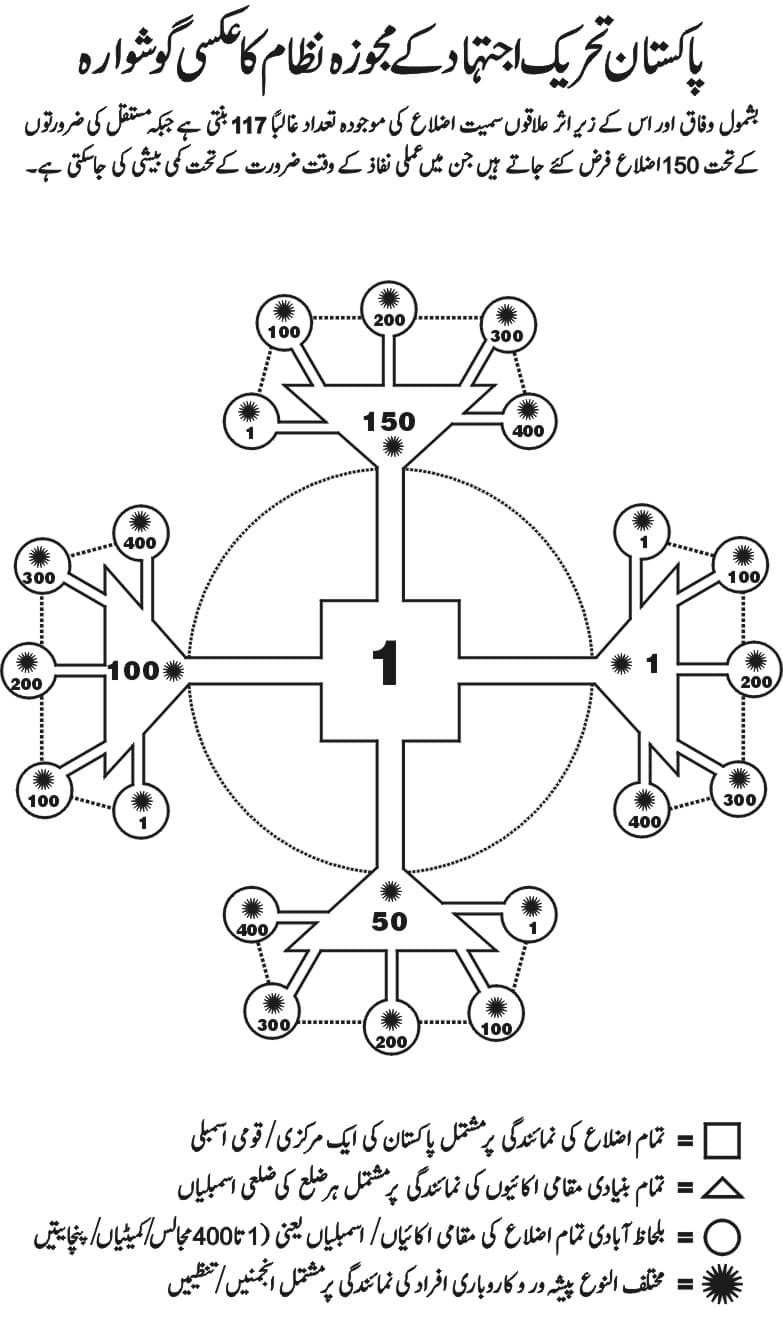
Clause 3(G): Archival Devolution Schematic (Goshwara)

Source: Constitution booklet, p. 50

The archival Goshwara schematic diagram illustrating the tripartite administrative and devolved organizational model, connecting central organs down to 1,000 local assemblies and neighborhood councils.

Source: Constitution Booklet, Page 50, Goshwara Devolution Matrix.

Clause 3(G): Archival Devolution Schematic (Goshwara)
Clause 3(G) Devolution Schematic

Archival diagram illustrating the tripartite administrative and devolved organizational model documented in Clause 3(G) of the party constitution.

Clause 4ضمن - 4
Source: Constitution booklet, p. 50

Term of Office & Meeting Proceedings

دفتری معیاد اور اجلاسوں کی کارروائی

The standard term of office for all elected councils and executive units across all tiers is four (4) years. Internal elections for successor leadership must commence three (3) months prior to the expiration of the term.

During the initial organizational phase, tenures remain subject to performance review pending nationwide rollout, with the Founder continuing as Central President. Organizational proceedings are open to public observation to maintain absolute transparency.

Clause 5ضمن - 5
Source: Constitution booklet, p. 50–51

Vote of No-Confidence

عدم اعتماد کی تحریک

A vote of no-confidence may be initiated against any elected office-bearer for non-performance, constitutional breaches, or disciplinary violations, upon recommendation of the Advisory Council or internal requisition.

Requires a formal written requisition signed by at least one-fourth (1/4) of the voting membership, followed by a mandatory two-thirds (2/3) majority vote of the respective assembly to effect removal.

Clause 6ضمن - 6
Source: Constitution booklet, p. 51

Constitutional Amendment Power & Procedure

آئین میں ترمیم کا اختیار

Constitutional amendments cannot be arbitrarily decreed. Formal proposals require initiation by at least two-fifths (2/5) of all district organizations, followed by general body voting / referendum.

During the transitional organizational phase prior to full national devolution, the Founder/Central President in consultation with the founding Advisory Council holds authority to enact necessary structural adjustments to ensure statutory compliance.

Clause 7ضمن - 7
Source: Constitution booklet, p. 51–52

Party Election Commission

پارٹی کا الیکشن کمیشن

Establishes an independent eleven (11) member Central Election Commission responsible for conducting transparent elections across all organizational tiers.

The Chief Election Commissioner, Secretary, and members are appointed from the Advisory Council (Mehfil-e-Mudabbiran) to maintain electoral integrity, supervise voter rolls, and certify results.

Constitutional Sub-Clauses & Detailed Framework

7(A)

Clause 7(A): Dispute Resolution, Suspension & Reinstatement Tribunal

Source: Constitution booklet, p. 52

Internal party disputes, electoral grievances, and disciplinary allegations are investigated by a seven (7) member Arbitration Committee providing due process and fair hearing guarantees.

The Chief Election Commissioner renders decisions within thirty (30) days. Aggrieved parties retain the right to appeal before a nine (9) member Central Appellate Tribunal whose adjudication is final within the party.

Clause 8ضمن - 8
Source: Constitution booklet, p. 52

Financial Audit

آڈٹ

Mandates comprehensive statutory financial audits conducted annually by a seven (7) member Audit Committee appointed from the Advisory Council, chaired by the Central President with the Patron-in-Chief serving as Secretary.

Subordinate tiers maintain corresponding audit units reporting directly to the Central Audit Committee, ensuring serialized bookkeeping, bank transparency, and statutory submission readiness.

Clause 9ضمن - 9
Source: Constitution booklet, p. 52–54

Operations, Conduct & Field Activities

اعمال و افعال

Regulates field operations, public assemblies, and mass contact across all districts and towns. Mandates that party gatherings be held in open public spaces rather than luxury elite hotels.

Literature and ideological texts are disseminated directly to citizens, advancing the "Unite & Rule" doctrine through peaceful and lawful democratic means.

Constitutional Sub-Clauses & Detailed Framework

9(A)

Clause 9(A): Membership Qualifications & Disqualifications

Source: Constitution booklet, p. 52–53

Eligibility: Open to working-class citizens, peasants, industrial laborers, small shopkeepers, street vendors, transport workers, students, teachers, conscientious lawyers, and overseas Pakistanis who affirm the constitutional oath.

Disqualification: Explicitly debars feudal landlords hoarding excessive agricultural acreage, corrupt oligarchs, usurers, beneficiaries of fraudulent loan write-offs, perpetrators of white-collar crime, sectarian extremists, and armed militias until they undertake verifiable moral reform.

9(B)

Clause 9(B): Contributions, Dues & Party Funds

Source: Constitution booklet, p. 53

Voluntary contributions may be donated by any citizen. Registered membership requires a minimum monthly contribution of Rs. 50 and a one-time registration and certificate fee of Rs. 500.

Members failing to pay dues for three consecutive months lose voting eligibility; failure to pay for six months results in automatic lapse of membership. Serialized official receipts are issued by the Finance Secretary.

9(C)

Clause 9(C): Specimen Membership Application Form

Source: Constitution booklet, p. 53

The official standardized membership form specimen capturing personal particulars, CNIC, permanent address, dual attesting witnesses, and the constitutional affirmation pledge.

9(D)

Clause 9(D): Specimen Membership Certificate

Source: Constitution booklet, p. 54

The official verified membership certificate specimen bearing the party crest, serialized national registration number, date of issuance, and executive seal of the Central President.

Clause 10ضمن - 10
Source: Constitution booklet, p. 54

Ratification & Adoption Resolution

منظوری

Records the unanimous adoption of the Party Constitution and Manifesto at the foundational party convention convened on 06 February 2017, ratifying the interim central executive organization and Advisory Council.

Signatories resolved to formally submit the constitution to the Election Commission of Pakistan (ECP) in Islamabad, authorizing the Founder to complete statutory enlistment formalities.

Clause 11ضمن - 11
Source: Constitution booklet, p. 54

Central Working Committee Register

مرکزی کارفرما تنظیم

Official statutory register of the Central Working Committee (Central Executive Organization):

Entry No. 1: Altaf Hussain Anwar s/o Muhammad Ibrahim Saqi, Resident of C-13 Civil Area, Okara Cantt, Punjab; Office: Central (National) President & Founder.

Clause 12ضمن - 12
Source: Constitution booklet, p. 54

Advisory Council / Special Aides (Think-Tank)

محفلِ مدبران / معاونینِ خصوصی

Official statutory register of the Advisory Council / Special Aides (Mehfil-e-Mudabbiran):

This institutional think-tank provides high-level ethical, strategic, and economic counsel to the central party leadership.

Archival Document Footnote: "Note: This constitutes the definitive concise summary of the party constitution."

Return to Constitution Foundation Overview

The provisions displayed above represent the internal rules and governing charter of Pakistan Tehreek-e-Ijtihad as registered with the Election Commission of Pakistan.